
- Home
- Are Bitcoin mixers legal
Are Bitcoin mixers legal?
Short answer: in most places, privacy is legal and so is using your own coins privately. The longer answer depends on where you live, which service you touch and where the coins go next. This page sums up the 2026 picture in plain language.
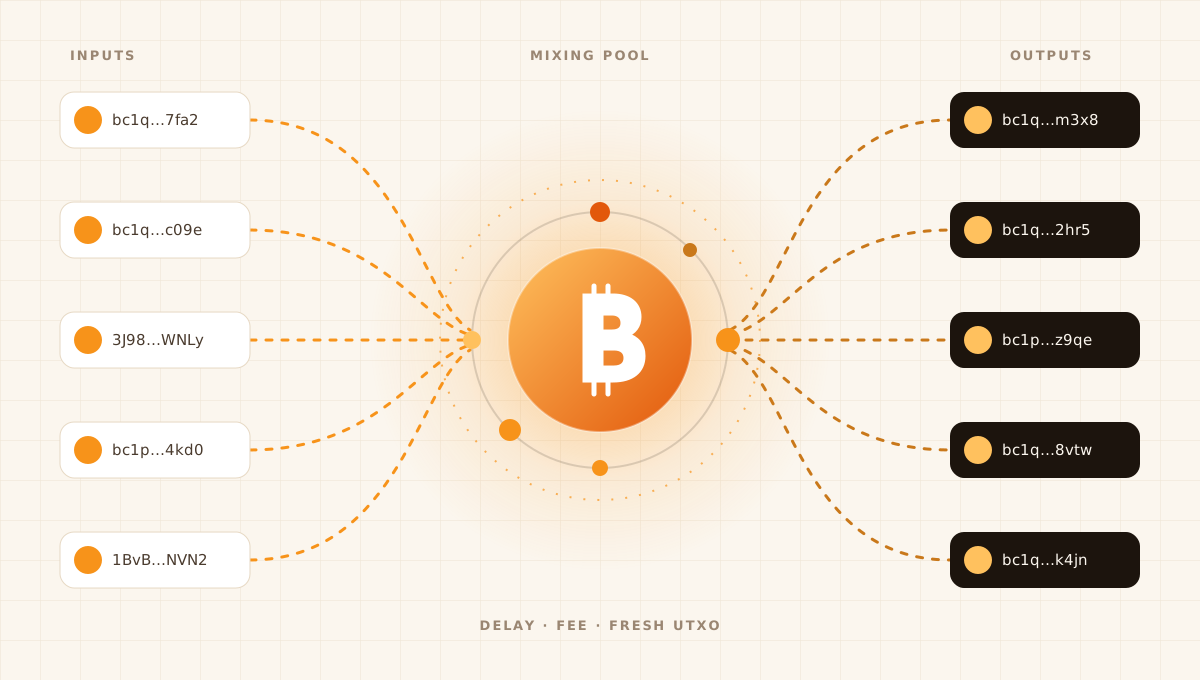
Privacy is legal; context matters
No major jurisdiction has a law that simply says "using a Bitcoin mixer is a crime." Financial privacy is widely recognised as legitimate, and people mix coins for ordinary reasons: keeping a salary or a business supplier list out of public view, or protecting a donation to a sensitive cause.
The legal risk sits in two places. First, operators of custodial services may count as money transmitters and need a licence they usually do not have. Second, the origin of the funds: if coins come from a crime, mixing them is treated as an offence in itself. For an ordinary user with documented, lawful funds, the practical risk is usually not prosecution but friction with exchanges.
Bitcoin mixers in the United States
FinCEN guidance from 2019 states that a business accepting and transmitting coins as an anonymising service is a money transmitter and must register. In October 2023 FinCEN also proposed a rule that would add reporting duties for transactions involving mixing.
Enforcement has targeted operators rather than individual users. The operator of Bitcoin Fog was convicted in 2024, and the founders of Samourai Wallet pleaded guilty in 2025 to running an unlicensed money transmitting business. On the other side, the Treasury removed Tornado Cash from its sanctions list in March 2025 after a federal appeals court ruled that immutable smart contracts could not be sanctioned as property.
Crypto mixer rules in the EU and UK
Travel rule now, stricter rules from 2027
Since December 30, 2024, crypto providers must attach sender and recipient data to transfers. The new EU AML regulation, applying from July 2027, bars regulated providers from keeping accounts that hide the holder or from handling privacy-enhancing coins. Personal use of a Bitcoin mixer is not banned, but regulated firms will look harder at its outputs.
Registration and risk checks
Crypto firms must register with the FCA and apply the travel rule. There is no specific ban on mixing for individuals, yet UK exchanges treat mixed coins as higher risk and may ask questions.
Elsewhere the picture varies widely. Japan and South Korea keep strict exchange rules, while many countries have no specific guidance at all. If in doubt, ask a local lawyer.
What happens when mixed BTC reaches an exchange
Large exchanges screen every deposit with analytics tools. Coins that arrive directly from a known mixer address often receive a high risk score. Typical outcomes range from nothing at all, to a request to explain the source of funds, to a temporary hold while compliance reviews the case.
The best protection is boring: keep records of how you originally obtained the coins, such as exchange statements, invoices or mining payouts, and be ready to share them. Honest documentation resolves most reviews.
A practical compliance checklist for BTC mixer users
- Mix only coins whose origin you can document.
- Avoid services that appear on a sanctions list in your country.
- Read the terms of every exchange you use; some forbid deposits from mixers.
- Report gains and losses as your tax rules require; mixing does not change that.
- Keep order IDs and guarantee letters in case you need to explain a transfer.
Understand the method first
A step-by-step look at what happens to your coins inside a Bitcoin mixer.